
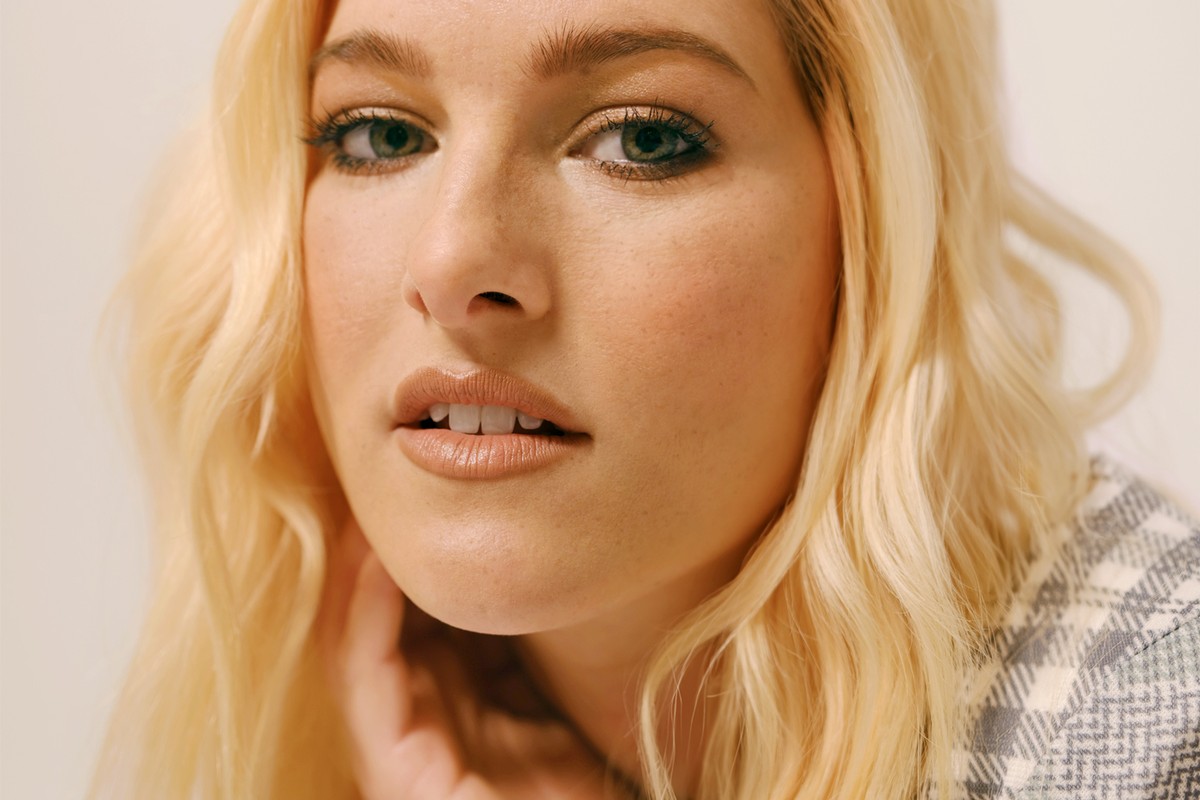

The folder had been sitting unopened on Cassadee Pope’s computer desktop for years when she finally deleted it. It was a collection of photographs taken with mostly male country-radio programmers whom she’d been expected to suck up to, snapped every time she went to a station to promote her music or hosted a meet-and-greet backstage at a concert. As soon as she got home, she’d print them out, sign them, and mail them off with a little note.
“That took like a half a year of my life,” Pope says, shaking her head in disbelief at a Nashville café. She’s wearing a Sublime T-shirt, and her hair is a bleached-out sort of peachy pink. She can laugh at it all now — at the Music Row machine and the ridiculous balance of power between radio and art, and at how, no matter how many pictures she mailed out, egos she massaged, or nice little text messages she sent to programmers (because, as she says she was told, Luke Bryan does this all the time), she still never got a Number One country song. “I was so dedicated and determined to get in nice with everyone,” she says. “Some people I genuinely liked, but others I was tipped off that, ‘Oh, this person expects a friendship or some sort of communication, so if you don’t give it to them, they’re probably not going to play you on the radio.’”
She can laugh at it all now because it’s no longer her world. Pope’s newest music — and the kind she’s committed to making going forward — is a return to her roots and the sound that launched her career in 2008 when she fronted the pop-punk band Hey Monday. That was before she won the third season of The Voice in 2012. Pope’s voice — a crystal-clear, emo-ballad powerhouse that Nashville grossly undervalued — had always felt like it was itching to explode through the gauze of Music Row production, and her live shows skewed toward rock no matter how much the instruments onstage tried to twang the edge away. For years, Pope made it work, sculpting the two disparate sounds into something that felt like her. “Anyone who has seen me play, it’s a rock show,” she says after ordering a coffee from a waiter who she knows by name. “Even when I was doing country music, I would make the guys go into halftime parts and just really rock it up. Because that’s my favorite thing.”
Still, Pope dutifully played the country radio game for close to a decade. But by 2020, she had been shelved and subsequently dropped by her label. Trying to find a way to merge both her emo self and her Nashville self, she started making music under the “y’allternative” umbrella: The album, Thrive, wasn’t exactly a success. “It flew completely under the radar,” Pope says. “I think it confused the algorithm.” It didn’t get playlisted in country or alternative. Trying to please everyone, a habit she can chart back to her days as a teenager playing for entire rooms of label executives several times her age or even as a child of divorce, was no longer working on any front.
Pope didn’t make a conscious choice to depart country music as much as she decided to return to a genre where she felt most at home. But it’s a decision that was validated when some of the genre’s most publicized moments of late involved racism or anti-trans rhetoric (more on that, and the Brittney Aldean “insurrection Barbie” incident later). Deleting those radio-programmer photos, and any need to sacrifice herself for an industry that only awards one chosen white woman a year, at best, was just the catharsis she needed.
“If this is a genre that I absolutely can’t let go of, I’m just kind of being complicit,” Pope says about her mindset. A few years ago, she found she wasn’t really listening to country music anymore, specifically anything on country radio. Once she started to reckon with the genre’s complex and deeply rooted history of racism, she found fewer and fewer reasons to stick around. “I realize every genre has problematic people in it. I’m not saying there’s not a frontman in a band who hasn’t been accused of something in rock music. But I guess rock is in my bones more. You’re not completely ostracized and shamed for speaking out.”
And speak out she has. Pope had rarely ever publicly said anything vaguely political or activist-leaning before 2020, mostly because she was “completely uneducated on cultural issues,” she says. “There’s no good reason for not being aware, but I just wasn’t. I didn’t have any sort of passionate feelings about anything because I was so consumed with myself. It really took Covid to get me to sit down and focus on something other than myself and my career.” When her music started to drift further and further away from the confines of country, so did her comfort in the silence she used to retreat in. She started reading and educating herself about white supremacy and intersectional feminism. And then the Morgan Wallen video happened.
Pope was at home when she learned that Wallen was recorded on camera using a racial slur. Outraged, she quickly posted to her social media accounts — maybe a little too quickly. “I’m disgusted,” she wrote. “What happened does not represent all of country music.” She cringes now thinking of the tweet. As plenty of people in her replies pointed out, a successful white male artist feeling empowered to use that language without so much a thought was well within reason.
“I look back on it and I’m like, ‘You’re so annoying,’” she says of the post. “I was just another angry white person who just learned about racism. If that were to have happened today, I would have had a different response.” Pope left the tweet up intentionally: She wanted to cop to where she might have gone wrong. Her next step was to learn and listen. While other country artists preached racial equity while continuing to write in all-white rooms and play with all-white bands, Pope quietly consulted a database of Black musicians and improved her hiring practices and whom she collaborated with. She looks visibly uncomfortable talking about it all, though. “Why or how would I even promote that?” she says. “What I am I supposed to say, ‘My bass player is Black, look at me?’”
Nonetheless, she was one of the few white artists in Nashville who did more than just post a black square on Instagram. “She has walked the walk,” says artist Stephanie Jacques, a frequent co-writer of Pope’s. “During 2020, she wanted to learn and advocate for artists and the BIPOC community as a whole. I know firsthand because she held space for me. She is among a small group of artists that has asked the questions, craved learning and called out behavior that is rooted in hate and oppression on her platform.”
Pope’s most notorious confrontation came in 2022 with Brittany Aldean, the wife of country superstar Jason Aldean, in response to a transphobic post the beauty influencer wrote thanking her parents for “not changing my gender when I went through my tomboy phase.” Pope had had enough, and her message this time was thoughtful and deliberate: “You’d think celebs with beauty brands would see the positives in including LGBTQ+ people in their messaging,” she wrote. “But instead here we are, hearing someone compare their ‘tomboy phase’ to someone wanting to transition.” Maren Morris’ now famous “insurrection Barbie” comment was actually a reply to Pope’s original post. Death threats to Pope and Morris became a regular occurrence while the Aldeans doubled down, and both women were shocked by how little country music’s institutions seemed to be invested in their safety.
“In that moment, I felt so proud,” Pope says. “I had no feeling of regret. I just kept my head down and kept going. It’s only been the past few months that I’ve let my guard down in therapy and said, ‘Wait, I actually wasn’t OK.’ But I think that kind of comes with the territory of including activism in your life. You’re not going to please everyone.” She stays connected to country music through her friends like Brittney Spencer, Mickey Guyton, Jacques, and Morris. But, otherwise, she tunes it all out. Sometimes collaborators in New York or Los Angeles will ask her to explain “the dumpster fire” going down in Nashville. She’ll just shrug.
Pope doesn’t regret her decision to come to Nashville as a country artist after winning The Voice as a member of Blake Shelton’s team. At the time, it made perfect sense. Having grown up on Shania Twain in small-town South Florida, a switch to the genre was a natural fit for her massive voice and love of a good guitar solo, which, in a 2012 landscape dominated by acts like Psy and “Gangnam Style,” were increasingly rare. Sometimes, in her Hey Monday days, people would comment on how they caught a little bit of twang in her voice, a slight country inclination. Looking back on it, she thinks maybe she was just going where the guitars were. She loved country music, though — even as she spent the next decade having to prove it.
As soon as she won The Voice, she hit the road opening for Rascal Flatts and fitting in radio promotion stops along the way. She’d show up to a country station and perform for programmers, who were often eating pizza in the conference room on their lunch break while she sang. Sometimes, she says, her own rep would start talking up another artist on her label while she was sitting right there, on a visit she paid for herself. “Between flights, hotels, food, all of it, I was probably in the hole for at least half a million,” Pope says. “It was just insane.” “Wasting All These Tears” peaked at Number 10 on country radio in 2013, a veritable failure by the standards of Music Row that demands a Number One for increased investments. No song, in fact, by a solo female artist, hit Number One on the airplay charts that year. (Pope’s sole Number One came in 2016 as a guest vocalist on “Think of You” — a song written and recorded by Chris Young.)
While touring with Hey Monday, including stops on the Warped Tour, Pope had gotten used to being the only woman in the room and initially mistook misogyny for privilege. “I didn’t really identify it as sexist at the time because I wasn’t educated on it,” she says. “If anything, I’d think, ‘Oh, I must be really special to be the only girl doing this or that.’” She’d also established a well-built protective wall around herself, especially when it came to making those men that surrounded her comfortable. Back in Hey Monday, she remembers being told not to tan too much, because her team claimed “people in the Midwest didn’t understand a tan emo girl.” By the time she got to Nashville, she was used to doing whatever she had to do to win approval.
Pope’s Voice deal landed her at Republic Records, and eventually at Big Machine, which shelved an album before dropping her. She released the single “Take You Home” independently in 2019, but without a major-label promo team, any attempts to get the song traction on radio went nowhere. By 2022, her music fully migrated back to pop-punk with “People That I Love Leave” and “Almost There,” the latter of which celebrates female sexuality and pleasure in a way that would never be permitted in mainstream country. Sample lyric: “Bad things are fun when we’re naked/Pull my hair to show you care/I’m almost there.”
“Almost There” was written while in California with a team of collaborators who didn’t flinch when Pope kept pushing the envelope lyrically (Pope made several writing trips out west, borrowing Guyton’s car to get around). “I was freaking out inside,” she says, “being like, ‘Am I really going to say this?’ But they were so chill.” Pope grew up Catholic, well primed for the chaste environment of country radio, where even a woman singing “kiss lots of girls, if that’s what you’re into” is a step too far. “Getting caught kissing in the hallways or discovering masturbation and being shamed for it cemented in me that sexuality and sex and being in touch with that side of yourself was painful,” she adds. “Leaving a genre where you don’t really hear women singing about that kind of thing, or, God forbid, they wear something scandalous, it just felt really fresh and exciting.”
When the 10-year anniversary of “Wasting All These Tears” rolled around, she celebrated her break from country by releasing a “Cassadee’s Version” in full pop-punk mode. And, yes, the Taylor Swift nod is intentional: They both were once signed to Big Machine, after all. “I was just ready to change people’s perception of me,” she says, “so that I can really just start this chapter of saying whatever I want.”
A new album will be out, she hopes, by the spring. It’s got plenty of big, belting emo moments and “explosive choruses.” One song features rapper Daisha McBride, and Pope wants to incorporate some hardcore screaming action. She’s been writing with childhood friend Ali Tamposi, known best for her work with Kelly Clarkson and Camila Cabello, and she’s found a seamless continuation of her Hey Monday days — just a little older and wiser and no longer worrying about pleasing anyone but herself.
There’s no better timing for it: Pop punk is back. Artists like Olivia Rodrigo have sent new generations down Spotify wormholes that lead to bands like Hey Monday, and nostalgia tours are packing arenas (and driving TikTok trends). Pope made an appearance at one of them, the monster emofest When We Were Young, alongside Simple Plan and Yellowcard. Hey Monday will be reuniting at 2024’s festival this October, with all five original members.
“We’ve been collaborating with Cassadee since she sang on the acoustic version of ‘Hang You Up’ back in 2011, so it’s been awesome to see her returning to her pop-punk roots,” says Yellowcard’s Ryan Key, who invited Pope to sit in with the band on their comeback Good Morning America performance in January. “She is such an unbelievable talent.”
There are no plans for a proper Hey Monday album, but playing together again has been healing. Part of the reason the group broke up after only three years together was the inner conflict among bandmates — Pope, who was 17 when she got a record deal, was the only one actually signed. It was hard to keep a steady lineup, and the balance of power was off from the start. “We willingly put female frontpeople in the villain position,” she says. They’ve been doing a lot of healing, and group texts planning their When We Were Young set have been rolling in fast. Maybe, they’re realizing, Hey Monday were just a little bit ahead of their time.
Pope’s been thinking of other ways she can branch out, too. She’s been taking acting classes, nervously working through scenes with her partner, the actor-musician Sam Palladio (Pope likes the idea of singing on Broadway, especially). They live together in East Nashville, and she’s planning on meeting him for a bite to eat shortly. As for country music, she’s not looking for closure. “I don’t even know what that would look like,” she says, staring down into her coffee as if she is searching for an answer in the cup and coming up empty.
Instead, she’s just following the guitars.
“I have a tendency to either be late to things or to be early,” Pope says. “But rock music has come back in such a forceful way that no one can really ignore it. Now I feel like, ‘Wow, I might actually be at the right place at the right time.’ Finally.”


Jay-Z Deserves the Super Bowl Halftime Gig