Skip to content
Search

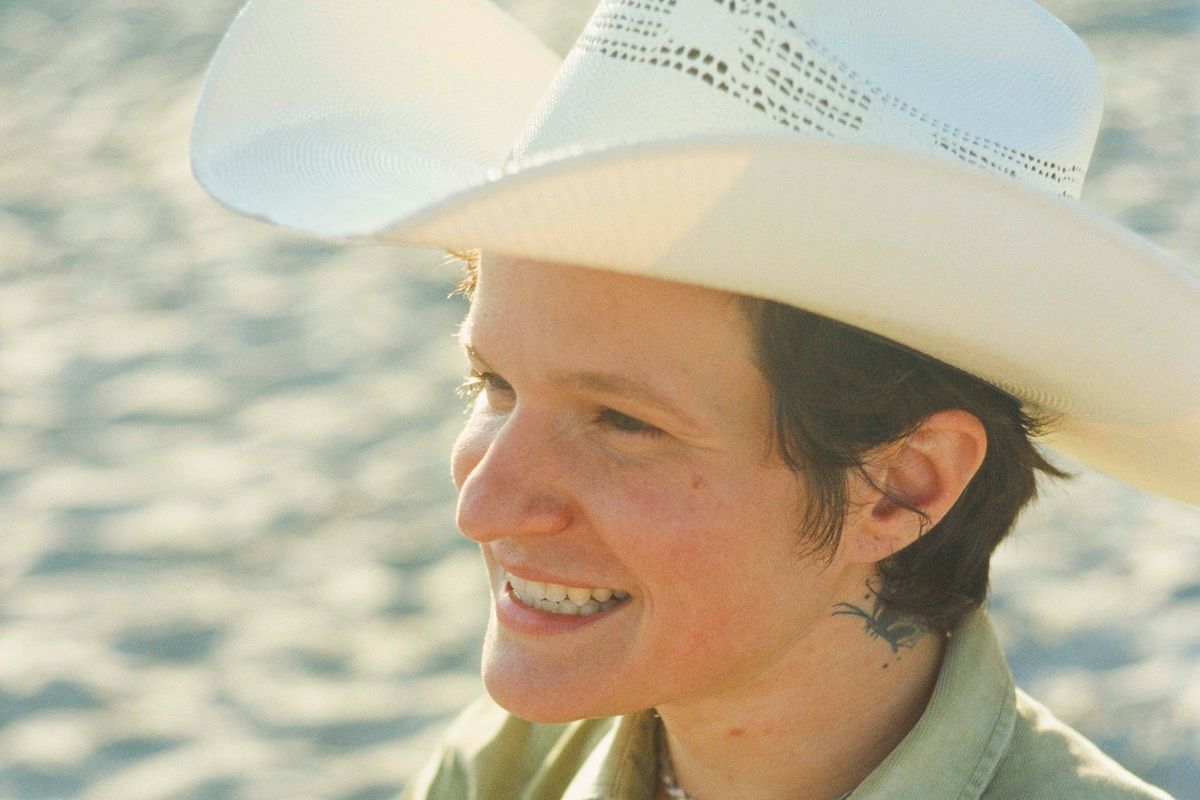
Adrianne Lenker Offers a Candid Image of Hopefulness and Heartbreak on ‘Bright Future’

Adrianne Lenker Offers a Candid Image of Hopefulness and Heartbreak on ‘Bright Future’

For Adrianne Lenker, love is meant to be a familial undertaking: she’s less interested in its early volatility, the thrills and frills, fantastical projections. She stated it clearly on “Anything,” a track from her 2020 album Songs, when she sang, “I don’t wanna be the owner of your fantasy/I just wanna be a part of your family.” For nearly everyone, our first experience of intimacy and love comes from our family units –“We look at the world once, in childhood. The rest is memory,” poet Louise Glück wrote in “Nostos”–and we spend the rest of our lives replicating those dynamics, for better or for worse.

Lenker confronts her own childhood in “Real House,” the melancholy opening track of the Big Thief singer-songwriter’s fifth solo album Bright Future. Over a gentle piano, she lists off a smattering of recollections with a heaviness that makes them feel more like a pile-up of grief: moving into a house by a field, the movie that scared her as a 7-year-old, the first time she saw her mother cry. Lenker is 31 now, but those memories are still razor-sharp, and her feelings about them just as intense. “Mama, what happened?” she sings. “Your love is all I want.”


The following 11 tracks on Bright Future follow Lenker moving through junctures of hopefulness and heartbreak within various relationships. It’s a body of incantations that explore reconciliation, resignation, and reverence. “To the ocean of your love, I am a river,” she sings on the twinkling “No Machine,” with the repeated refrain of “don’t know what I’d do without you” providing a cushy landing like a nursery rhyme. Amidst the twisty mirrored wordplay of “Evol,” Lenker sneaks in the plea “you have my heart, I want it back,” a statement so clear and concise that it cuts straight through the song’s lyrical diversions. 

Lenker mourns the end of a relationship with equal parts solemnity and grace on “Sadness As A Gift,” swollen with a desire to forgive. “You could write me someday and I hope you will,” she sings over twangy guitar pluckings, propping a door open for the potential mending of a broken bond. On “Fool,” another familial motif reappears: “We could be friends, you could love me through and through/If I were him, would you be my family too?” 

Bright Future carries an aura of raw, one-take candidness. Lenker recorded the album in an analog studio in the woods with collaborators Philip Weinrobe, Mat Davidson, Josefin Runsteen, and Nick Hakim. It’s sweet and subtle in its sound, though Lenker’s lyricism remains characteristically brutal and brave. The tracks share a similar sparseness and uniformity in instrumentation–piano, violin, guitar, and occasional percussion–but rather than meld together, each song stands strong, poignant and singular. At certain points, the recordings pick up clacks on the floorboards, tapes winding, studio chatter. If you listen closely to “Free Treasure,” you’ll even hear Lenker and Davidson nearly flub a lyric during while delivering the line “when I thought I couldn’t feel more, I feel a little more.”

The entire project is a practice in presence, solidifying Lenker’s beliefs the very moment they’re born, taken as truth. It’s also an emotional free-fall, as Lenker expresses her thoughts without fear of how they might hold up down the line. Bright Future’s recording style mirrors the listener’s experience: as time goes on, these songs and the emotions associated with them will inevitably deepen, transmute, and attach themselves to the memory of different people. 

That urgency to seize the current moment is most prevalent on the hymn–like “Donut Seam,” where Lenker nods to the fated end of all things–“This whole world is dying,” she sings alongside her collaborators – but that’s just why it’s the perfect time to swim, to kiss, to get lost only to find.


More Stories

Florence Welch: ‘Anxiety is the Hum of My Life — Until I Step Onstage’
Thea Traff

Florence Welch: ‘Anxiety is the Hum of My Life — Until I Step Onstage’

If you talk to Florence Welch on any given day, it’s safe to assume she’s feeling a little anxious. “Anxiety is the constant hum of my life,” she says. “Then I step out onstage, and it goes away.”

Luckily, that’s where she is right now: draped in a long white dress, sitting comfortably in front of a 150-person audience at New York’s beautiful Cherry Lane Theatre, a storied downtown venue known as the birthplace of off-Broadway theater. It’s a week before the release of Everybody Scream, the excellent sixth album she made with her band, Florence + the Machine, and Welch is here for the first-ever live edition of the Rolling Stone Interview, the magazine’s long-running deep-dive conversation series. (The interview is also the first-ever video podcast version of the franchise — check it out on Rolling Stone’s YouTube channel and wherever you get your podcasts.)

Keep ReadingShow less
Prevost: the Québec company behind the biggest tours
Photo via Prevost

Prevost: the Québec company behind the biggest tours

If you’ve ever wandered backstage at a festival or through the private parking lot of an arena during a concert, you’ve probably noticed something: a long row of tour buses. And if you looked closely, you may have seen the same name on every single one: Prevost.

The story of these coaches, like that of nearly every tour bus in North America, doesn’t begin in Los Angeles but just outside Québec City.

Keep ReadingShow less
Rolling Stone Québec Future of Music 2025
Drowster

Rolling Stone Québec Future of Music 2025

Alexandra Stréliski

We could list a lot of impressive figures to showcase Alexandra Stréliski’s success: 600 million streams, 100,000 concert tickets sold, 10 Félix awards, 2 Polaris nominations, 1 Juno…

Drowster

Keep ReadingShow less
Dominique Fils-Aimé Follows Her Heart and Own Rules

Kaftan: Rick Owens/Jewelry: Personal Collection & So Stylé

Photos by SACHA COHEN, assisted by JEREMY BOBROW. Styling by LEBAN OSMANI, assisted by BINTA and BERNIE GRACIEUSE. Hair by VERLINE SIVERNÉ. Makeup by CLAUDINE JOURDAIN. Produced by MALIK HINDS and MARIE-LISE ROUSSEAU

Dominique Fils-Aimé Follows Her Heart and Own Rules

You know that little inner voice whispering in your ear to be cautious about this, or to give more weight to that? Dominique Fils-Aimé always listens to it — especially when people push her to go against her gut instinct. The jazz artist doesn’t care for conventions or received wisdom. She treats every seed life drops along her path as an opportunity to follow her instincts. To go her own way. To listen to her heart. And it pays off.

The Montreal singer-songwriter tends to question everything we take for granted. Case in point: applause between songs at her shows. Anyone who’s seen her live knows she asks audiences to wait until the end of the performance to clap, so as not to break the spell she creates each time.

Keep ReadingShow less
Pierre Lapointe, Grand duke of broken souls

Cotton two-piece by Marni, SSENSE.com / Shirt from personal collection

Photographer Guillaume Boucher / Stylist Florence O. Durand / HMUA: Raphaël Gagnon / Producers: Malik Hinds & Billy Eff / Studio: Allô Studio

Pierre Lapointe, Grand duke of broken souls

Many years ago, while studying theatrical performance at Cégep de Saint-Hyacinthe, Pierre Lapointe was given a peculiar exercise by his teacher. The students were asked to walk from one end of the classroom to the other while observing their peers. Based solely on their gait, posture, and gaze, they had to assign each other certain qualities, a character, or even a profession.

Lapointe remembers being told that there was something princely about him. That was not exactly the term that this young, queer student, freshly emancipated from the Outaouais region and marked by a childhood tinged with near-chronic sadness, would have instinctively chosen for himself. Though he had been unaware of his own regal qualities, he has spent more than 20 years trying to shed this image, one he admits he may have subtly cultivated in his early days.

Keep ReadingShow less