
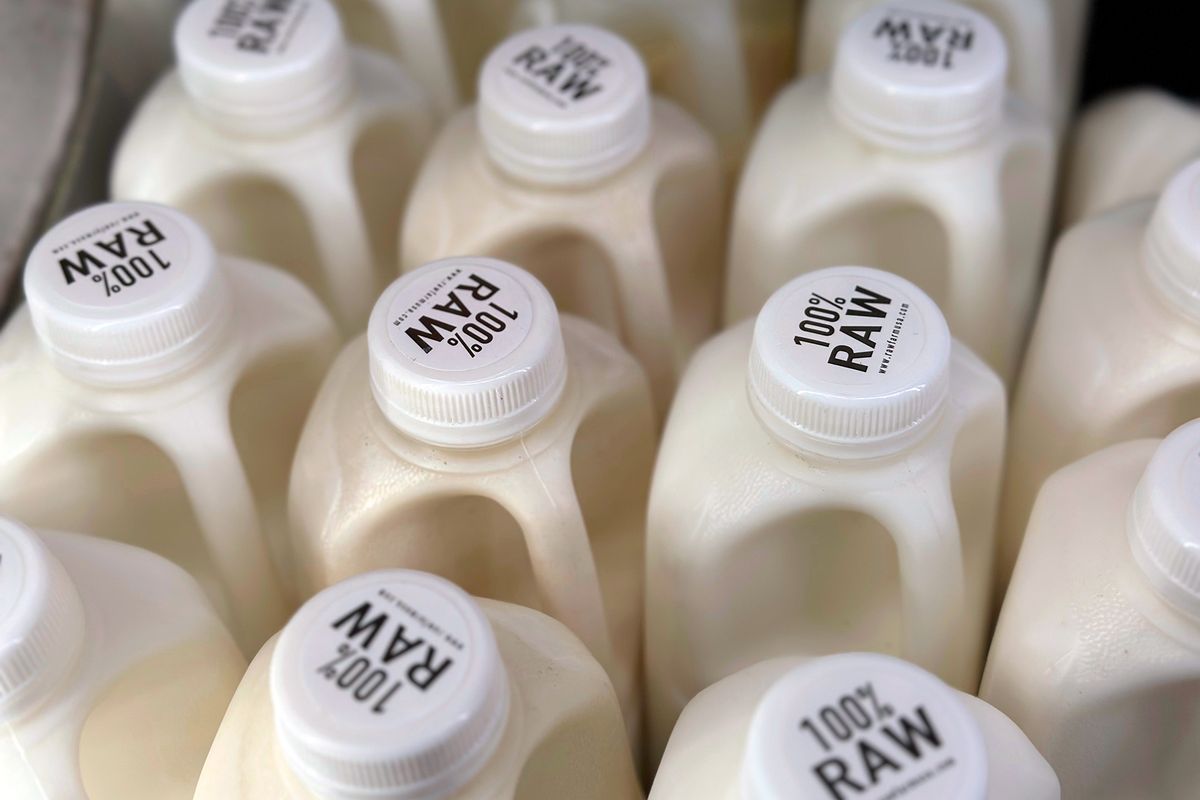

Earlier this month, the sound of mooing rang out in the chambers of the Louisiana capitol when the House unanimously voted in favor of a bill legalizing the sale of raw milk in the state. HB467 also passed in the state Senate, and if Republican Gov. Jeff Landry signs it into law as expected, Louisiana will join the vast majority of other states, where unpasteurized milk can be bought and sold legally — provided the label warns that it’s “not for human consumption” and potentially contains “harmful bacteria.” But, as Louisiana lawmakers have pointed out, the label isn’t going to prevent raw milk enthusiasts from drinking it anyway.
If anything, there’s been a recent surge of raw milk evangelism among conservatives, anti-establishment figures like Robert F. Kennedy, Jr., the tradwives and homesteaders on social media, and their patron saint, Gwyneth Paltrow — who says she drinks raw cream in her coffee every morning. While their unapologetic espousal of unpasteurized milk isn’t new, the debate — unlike the unprocessed dairy products — has been particularly heated since the H5N1 avian influenza virus was first detected in US dairy cows back in March, prompting the Centers for Disease Control and Prevention (CDC), Food and Drug Administration (FDA), and National Institutes of Health (NIH) to issue warnings against drinking raw milk.
Things began to boil over last week, thanks, in part, to the discovery that Charlie Kirk’s right-wing youth organization, Turning Point USA, had been selling “Got Raw Milk?” T-shirts that featured an illustration of a bull, not a cow. (The image on the T-shirt has since been updated.) But if you haven’t been keeping up with crunchy TikTok, the right’s latest attempt to undermine public health might appear to have come from nowhere. Here’s what to know about raw milk, including what people are claiming about it, whether it’s safe to drink, and why the dairy aisle has become the site of the MAGA crowd’s most recent anti-science battle.
Why are people talking about raw milk?
When people talk about “raw milk,” they’re referring to “milk that comes directly from a cow’s udder and has not been heat-treated or pasteurized,” says Bryan Quoc Le, PhD a food scientist, food industry consultant, and a faculty research fellow in the department of chemistry at Pacific Lutheran University.
According to James Fitzgerald, PhD, associate professor of security studies at Dublin City University, whose research focuses on conspiracy-led violent extremism, “post-truth” politics, and disinformation, the consumption of raw milk is the latest in a long line of social and political markers that sets the extreme right apart, “giving it a distinct identity as an alternative way of seeing — and raging at — the world.” Other examples include alternative diets, self-help, and bodily improvement trends.
While drinking unpasteurized milk isn’t illegal, it does go against the official guidance of federal agencies like the CDC and FDA, as well as mainstream medical expertise, “as we saw with extreme-right and conservative resistance to vaccination during the Covid-19 pandemic,” Fitzgerald tells Rolling Stone. “It provides individuals with a sense of agency, freedom, and control: one of the reasons why the topic taps into broad support among individuals who may not otherwise support far/extreme-right causes.”
Along the same lines, Céline Gounder, MD, an infectious disease specialist and epidemiologist at New York University and Bellevue Hospital, and editor-at-large for public health at KFF Health News, explains that for many people, promoting the consumption of unpasteurized milk is “a political statement.” She compared the situation to one she encountered as an aid worker in Guinea during the Ebola outbreak in West Africa, roughly a decade ago, “[when] people refus[ed] to wash their hands” as a “form of political resistance.”
The rise in the popularity of raw dairy products is also likely a symptom of the current state of healthcare in the country. “People don’t trust the [American] healthcare system — and with good reason,” Gounder tells Rolling Stone. “It’s first and foremost about profit, not caring for patients or cultivating a healthy population.” When people are poorly served by the healthcare system — because it’s too expensive, inaccessible, discriminatory, difficult to navigate, or unfriendly — Gounder says they seek alternatives like consuming raw milk that give them a sense of control.
Why do people think raw milk is good for you?
So, what, exactly, do people think are the benefits of drinking raw milk? Some, like Clint Rarey, the owner of a farm that produces raw milk, claim that it’s healthier than pasteurized milk because “you’re not killing out all the bacteria that you need to be consuming from it — it’s actually real food that hasn’t been altered or genetically modified,” he explained on an April episode of Infowars’ War Room with Owen Shroyer podcast.
More specifically, TikTok user @barnbellesophie — a self-described “woman built for the kitchen” and urban homesteader — claims in a post that raw milk contains “way more vitamins, minerals, and even healthy fats compared to pasteurized milk” and “has been shown to have great effects for autoimmune diseases, asthma, and sometimes even eczema.”
Disturbingly, by April 29, there were evidently enough people who thought that consuming raw milk contaminated with live A(H5N1) virus was a good way to develop antibodies against the disease that the CDC determined it was necessary to issue a food safety advisory explaining why that was a bad idea. For others, it’s part of a “natural” lifestyle. But, as Gounder puts it: “Drinking raw milk is about as ‘natural’ as drinking water contaminated with raw sewage. Pasteurization is no more ‘unnatural’ than cooking, refrigerating, or freezing food. We do all of these things to make food safer to consume.”
In reality, both Gounder and Le confirm that heating milk to pasteurize it doesn’t change its nutritional value. “There are no known scientifically valid benefits to drinking raw milk,” Le says. Most of the claims made about the supposed advantages of consuming unpasteurized milk come from a handful of inconclusive studies — many of which focus specifically on the so-called “farm effect” — which Le notes is still under investigation. The basic idea is that people who grow up on farms exposed to soil, animal dander, dust, and other environmental sources of allergens and microbes — like raw milk — are supposedly less likely to develop allergies.
While this correlation has been observed in some people who drink unpasteurized milk, according to Le, there’s a major caveat. In clinical studies testing for these benefits, “researchers still use raw milk that has been rendered microbiologically safe through other means of sterilization,” he says — something that likely doesn’t happen to the raw milk people are seen drinking on TikTok.
What are the health risks associated with drinking raw milk?
Although there’s not conclusive evidence of the health benefits of drinking unpasteurized milk, the risks are well-documented. Between 2009 and 2014, raw milk and cheese — which are only consumed by 3.2 percent and 1.6 percent of the U.S. population, respectively — are responsible for causing 96 percent of illnesses from dairy contamination, according to a 2017 study in Emerging Infectious Diseases, a peer-reviewed journal published by the CDC.
Prior to the widespread introduction of commercial pasteurization in urban areas in the early 1900s, milkborne illnesses including diphtheria, tuberculosis, and “summer diarrhea” were a major threat to public health. “The number of pathogens in raw milk is thousands or tens of thousands of times more than pasteurized milk,” Le explains. “Pasteurization is essential to reduce the number of pathogens to a level that is acceptable for the vast majority of the population to drink safely — especially those who have a compromised immune system.”
While several recent public health advisories have focused on the presence of H5N1 avian influenza virus in raw milk, Gounder says that people who drink unpasteurized milk also risk contracting E. coli, Salmonella, and Campylobacter bacterial infections, which are often accompanied by unpleasant symptoms like fever, diarrhea, vomiting, and abdominal pain. “These bacteria are present in the feces of cattle, and the undersides of cattle are highly contaminated with them,” she explains.
But that’s not all: E. coli infections may also cause hemolytic uremic syndrome (HUS), which, according to Gounder, is characterized by damage to blood vessels, blood clots, and kidney failure, accompanied by a drop in both red cells and platelets. Raw milk may also contain meningitis-causing Listeria bacteria, which may cause symptoms including headache, stiff neck, confusion, and seizures. “Infection during pregnancy can be highly morbid and fatal for a fetus or newborn,” Gounder adds.
What is the end-goal of the raw milk movement?
Given the potential risks of drinking raw milk, why are right-wing extremists, wellness influencers, and anti-establishment leaders encouraging others to guzzle it down? One reason, according to Fitzgerald, is that it helps to bolster other far- and extreme-right conspiracy theories, like the Great Reset — which is based on the idea that a globalist elite is pushing an agenda to remove meat and dairy products from modern diets, and replace them with plant-based and lab-grown alternatives. “At a minimum, this would infringe on individual freedom of choice,” he explains. “At worst, it would allow liberal globalist elites to contaminate new sources of food with chemicals and additives designed to pacify the masses, who would become apathetic to political change.”
In addition to potential political gain, there are also financial incentives. “Influencers make money from peddling snake oils — sometimes actually selling products, sometimes trading on the size of their audiences,” Gounder says. But social media content is the real moneymaker. “Influencers, for example, need to push out new content on a regular basis to hold the interest of their listener base and, in turn, generate a higher share of advertising revenue,” Fitzgerald says.
Lastly, drinking unpasteurized milk also provides another way for the extreme right to embrace idealized aesthetics of the past, alongside traditional gender roles, and policies that maintain and promote the status quo of white supremacy. “The consumption of raw milk — like the tradwife aesthetic, which is also leveraged by the extreme-right — is a lifestyle choice that harkens back to a ‘better,’ simpler time when traditional social hierarchies persist,” Fitzgerald explains. So while those promoting the consumption of unpasteurized dairy have set their sights on returning to a simpler time, all that raw milk is probably going to offer is an achy gut — or something much worse.





 David Manheim and Hunter Biden Courtesy of David Manheim
Everybody Likes Drake Again. That Means We’re Healing