
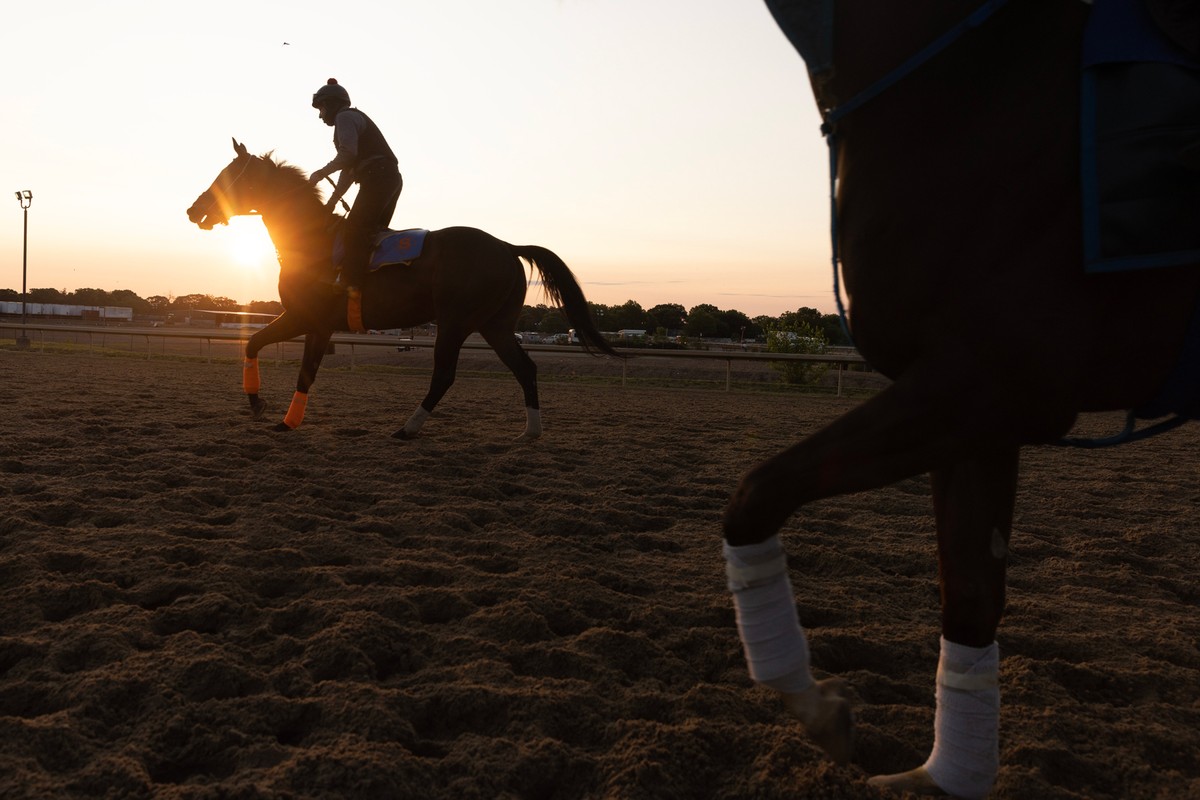

As millions of horse-racing enthusiasts tune into the 150th running of the Kentucky Derby on Saturday, the pageantry of “the sport of kings” will be on full display: magnificent thoroughbreds thundering down the muddy, mile-and-a-quarter-long track at Churchill Downs, a heavy-betting crowd in their most flamboyant finery cheering them on. But behind the lemon-colored sundresses and feathered headpieces, the iconic bugle call and the hold-your-breath excitement, one of America’s most storied sports is plagued with problems.
Corruption and a win-at-all-costs mentality have long been a part of horse racing, but in recent years that culture has led to dire consequences. More than two dozen people were charged in March 2020 for secretly distributing drugs to racehorses, following an FBI investigation. Last year marked a nadir: Twelve horses died at Churchill Downs in the days just before and after the Derby, and 13 more at the Saratoga Race Course over that summer.
In the wake of those controversies, Broken Horses, a new FX documentary produced by New York Times Presents and available on Hulu, takes a closer look at the systemic issues and questionable practices that have thrust the sport into crisis. Featuring interviews with trainers, jockeys, and medical professionals, it sheds new light on horse racing’s dark side, revealing a deadly pattern in an industry that works steeds past their limits.
“They’re just really pushing sore horses because [of] the money,” says Times reporter Melissa Hoppert, who is featured in the documentary. “The trainers need to win to keep their winning percentage up to get the best horses. So, they keep them out on the racetrack. They keep them in training.”
Here are four takeaways from the film.
One of the sport’s biggest names has become one of its biggest villains
Known for his dark shades, snow white hair, and brash swagger, Hall of Fame trainer Bob Baffert is one of the rare horse racing personalities to transcend the sport. One of only two trainers in history to win horse racing’s Triple Crown (victories at the Derby, the Preakness Stakes, and the Belmont Stakes), he’s raked in hundreds of millions of dollars over his four-decade career. He’s also had 30 horses flunk drug tests in that time and 74 horses die in his care since 2000.
After his 2021 Kentucky Derby winner Medina Spirit failed a post-race drug test, Baffert was suspended from Churchill Downs for two years and the horse was subsequently stripped of its title. While Medina Spirit tested positive for an excess of the steroid betamethasone, the film also notes that Baffert has been known to mix thyroid medication into his horses’ feed to help them slim down or to artificially build strength. Baffert’s Churchill Downs suspension was extended through 2024 (the racetrack accused him of continuing “to peddle a false narrative concerning the drug test of Medina Spirit”) and a Baffert-trained horse, Muth, was denied entry to this year’s Derby after a failed appeal last month.
Trainers use everything from cocaine to Viagra and frog venom to boost horses’ performance
Broken Horses lays out how money-hungry trainers will do virtually anything to give their horses an edge, especially when it comes to administering narcotics. They’ve injected cobra venom to block nerves and mask pain, frog venom, Viagra, or even cayenne pepper (applied under the horse’s genitals) to increase excitability. Jorge Navarro, a notorious trainer who proudly went by the nickname the “Juice Man,” resorted to blood builders, which boost red blood cell count to carry more oxygen to tissues, allowing horses to run faster. (Navarro was one of the 12 people charged in the FBI’s 2020 investigation, and was sentenced to five years behind bars after pleading guilty.)
The Horseracing Integrity and Safety Authority, founded in 2020 and governed by the Federal Trade Commission, launched an anti-doping program in 2023 to combat the use of both controlled and banned substances on race day. (Controlled substances including aspirin and ibuprofen can be safely and legally administered during training.) But the HISA’s tests “are only as good as the next drug that’s being developed,” Hoppert tells Rolling Stone. “So they need to stay on top of that.” Not to mention, Hoppert adds, that the HISA only controls what happens on the racetrack. The breeding and sale of horses, and any medical procedures that take place before race day, are “the wild west.”
The breeding business has exploded
While there’s significant money to be made on the track — the Kentucky Derby purse was raised from $3 million to $5 million for this year’s race — the real cash lies in the breeding shed. And Broken Horses contends that today’s horses are not only being put to stud sooner than ever, they’re also expected to produce nearly twice as many offspring as in years past. For example, the doc reports, 2022 Breeders’ Cup winner Flightline was pulled into the baby-making shed after just six race starts. The stallion later produced 152 mares, with each female offspring worth $200,000. (That’s a potential $30 million haul off of one horse.) “Back in the day, stallions were breeding less than 100,” Hoppert tells Rolling Stone. “So that just shows you how much it’s like an ATM in the breeding shed.”
Horses are now working 365 days a year — and injuries are on the rise
In the late-19th century, the horse racing calendar included several scheduled rest periods. Those days are no more. Now, racehorses are expected to perform at their peak all year long, making them vulnerable to fractures — and worse. In 2023, a Baffert-trained horse named Havnameltdown was euthanized after stumbling in a race due to a left ankle injury. Breeder Katherine Devall calls the death simply “an accident.” But the film suggests a direct correlation to the sport’s emphasis on round-the-clock performance.
“The most fatal things happen in the joints — the ankles, particularly,” says Joe Drape, a New York Times reporter featured in the documentary. “Think of a 1,200-pound animal on top of a Coke bottle, because that’s how their ankles and hooves are shaped, and they’re going at 35 miles an hour. So, if there’s something wrong there, it’s going to give [at] one time or another.”
Euthanization is the most common solution to the severe pain horses experience with broken bones. But Broken Horses shows that trainers are often keeping the animals hopped up on painkillers and anti-inflammatories to allow them to run through injuries; some horses have been given aspirin 365 days a year. Veterinarian Sheila Lyons, who reviewed Havnameltdown’s case, notes in the film that the horse had been injected with corticosteroids and hyaluronic acid to dull pain and lubricate his joints. “Continuing to train and race a horse that has significant pathology in one or more joints is abusive,” Lyons says in the doc.
In the case of the 12 deaths at Churchill Downs last year, an investigation found an increased risk of fatalities for horses with intensive exercise schedules. And an April HISA report on the 13 track deaths at Saratoga last summer revealed that 11 of those horses had fatal injuries to their fetlock (or ankle) joint, and three of those 11 had received corticosteroid injections within 30 days of a race. Three Saratoga horses were also found unfit to race before their collapse, according to veterinarians.
“Unless you give bones time to recover, they’re never fully going to recover,” Hoppert says. “If you keep racing on that, a fatal, catastrophic injury is almost inevitable. So they know this, they have science that says this. [Yet] there [are] no rules in place to prevent the over-running of the horses.”







 Variety via Getty ImagesDespite the online rumors, there’s been no hint of drama among the cast, and they have publicly voiced their support for one another in TV appearances and
 Artist Boo Patterson with her painting, “The People’s Husband,” in Liza Mandelup’s Luigi.Benjamin WhatleyADVERTISEMENT