
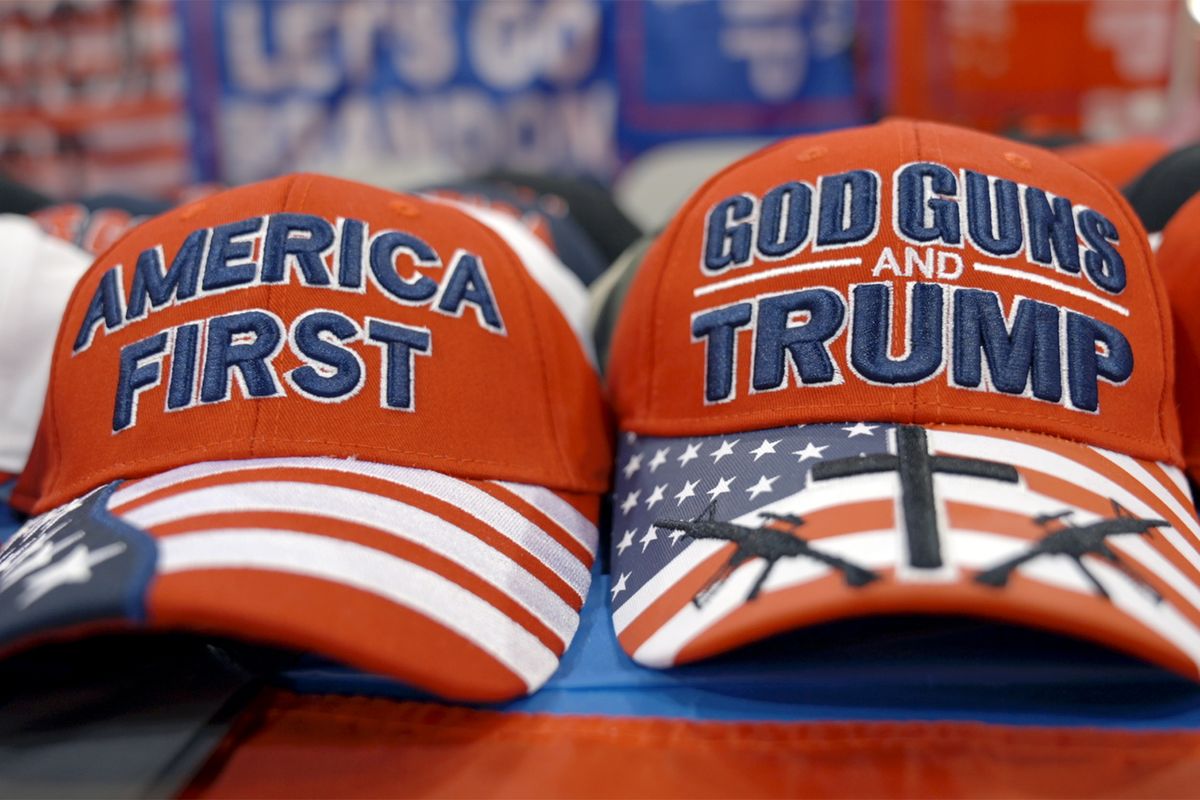

In a way, Rob Reiner has come full circle.
Decades ago, before The Princess Bride, before A Few Good Men, Reiner first made his mark as Michael “Meathead” Stivic, the liberal son-in-law to the racist, conservative Archie Bunker on one of the biggest TV shows of the 1970s, All in the Family. Week after week, Stivic stood up for liberal values in the face of Bunker’s jingoistic, racist nationalism. While conservatives loathed him, for progressives, he was one of the only voices of conscience on national television.
And now, half a century later, Reiner has co-produced the new documentary God and Country, which is like an extended argument with Archie’s descendants: the Christian nationalists who played a central role in the Jan. 6 insurrection, form the core of Donald Trump’s most committed base — and make Bunker’s racist patriotism seem almost quaint.
“Archie Bunker was a conservative and a patriot, but also a racist,” Reiner tells Rolling Stone. “And what we’re seeing now is the weaponization of that racism … These people [Christian nationalists] are fine with the idea that America should be a white, Christian nation. They’re frightened of what’s happening in this country with diversity. But we are a pluralistic society. E pluribus unum.”
According to God and Country, directed by Dan Partland and based on the book The Power Worshippers by Katherine Stewart, Christian nationalism has always been part of the American landscape, but took its current form in the 1950s, in the wake of Brown and the desegregation of public schools. It was then that right-wing, white Christians began realizing that their country was changing, and in response to Brown, they set up a network of so-called “segregation academies” — religious schools that, for a while at least, could still turn away nonwhite students.
But wait a minute – how is maintaining segregation a Christian issue? When did Jesus say that races should be kept separate?
As the numerous clergy and religious scholars in God and Country make clear, Christian nationalism is more of a political movement in religious garb than anything based in the Bible or Christian theology.
“Leaders of the movement often tell us this is about theology and religion,” Stewart said, “but this is not just about the culture wars or a dispute over theology. It’s a political war.”
As God and Country tells it, that war really got going in the 1970s, as “segregation academies” came under fire. Initially, movement leaders focused on an array of issues: fighting feminism, preserving “religious liberty” (i.e., the liberty to discriminate against Black people), and others. But one caught fire: abortion.
In many popular histories, the response to Roe v. Wade is what created the modern Christian right. But God and Country shows that, at first, Christian conservatives took little notice of it.
“The Christian nationalist movement started in the 1950s,” Reiner says. But by the 1970s, supporting segregation had become “an ugly, galvanizing issue. So they kind of dropped that and reenergized the movement with Roe v. Wade. But at the core of Christian nationalism is the white race.”
For nearly 40 years, the Christian nationalist movement won some battles, but kept losing the war. Yes, Ronald Reagan ushered in a new era of cultural conservatism. But Roe stayed on the books, America continued to grow more diverse, and with LGBTQ equality and same-sex marriage, it seemed to many Christian nationalists that the country was quite literally going to hell.
Enter Donald Trump.
On the surface, as Reiner explained, Trump would seem to be an unlikely hero to a conservative religious population: As one of the pastors interviewed in God and Country said, he was once held up as an embodiment of the seven deadly sins. “Seeing the rise of Trump,” says Reiner, “seeing the movement supporting this corrupt, failed pathological liar, I was very curious as to why this was happening. Why were they choosing this guy? In the past, evangelical Christians were big supporters of the Republican party — I understand that. But why support Donald Trump over Jeb Bush, who is an actual evangelical?”
The answer, says Reiner and several experts in the film, is power. Trump was seen — rightly, it turns out — as the “tough guy” who could deliver what “nice guys” could not. “This is the guy who’s gonna get it done,” one Christian-right leader said after meeting Trump in early 2016.
For many of the religious leaders interviewed in the film, Christian nationalism’s embrace of Trump was proof that the movement was never really based in Christianity, but in a particular kind of nativist ethno-politics. But among the Christian nationalist faithful, Trump became God’s chosen one who would set America on the right path. Indeed, Trump’s many personal failings were seen as proof that this was God’s hand at work. And indeed, Trump did deliver: Roe overturned, conservative Christian judges throughout the federal bench (handpicked by one of their own), and a validation of the worldview that America had lost its past greatness, and must fight to get it back.
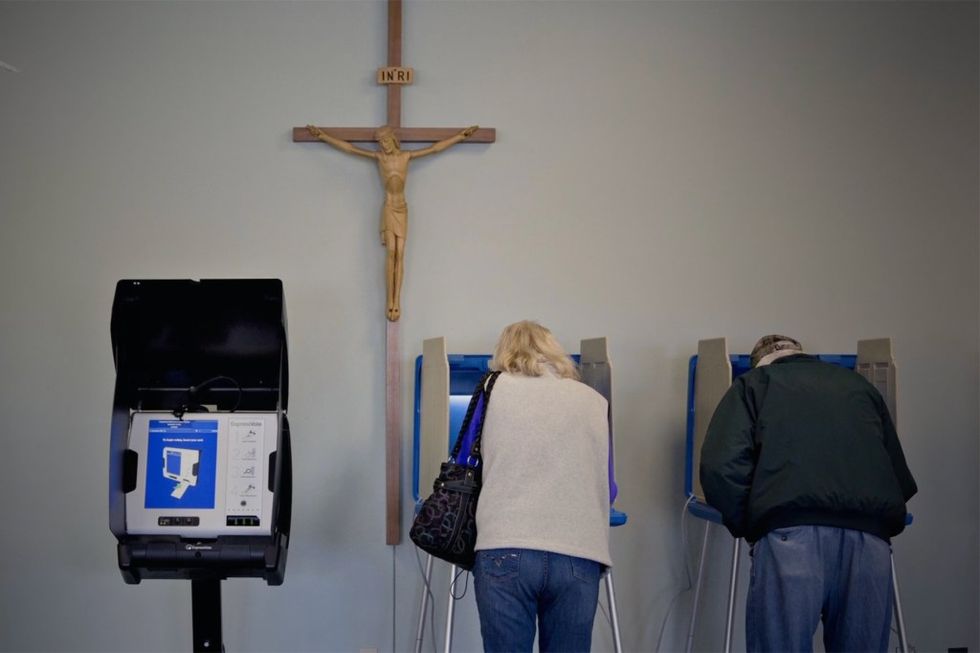
So it was theologically impossible for Trump to lose the 2020 election. In the eyes of Christian nationalists, “How could the election not be stolen?” asks Jonathan Seidel, a scholar of the movement, in the film.
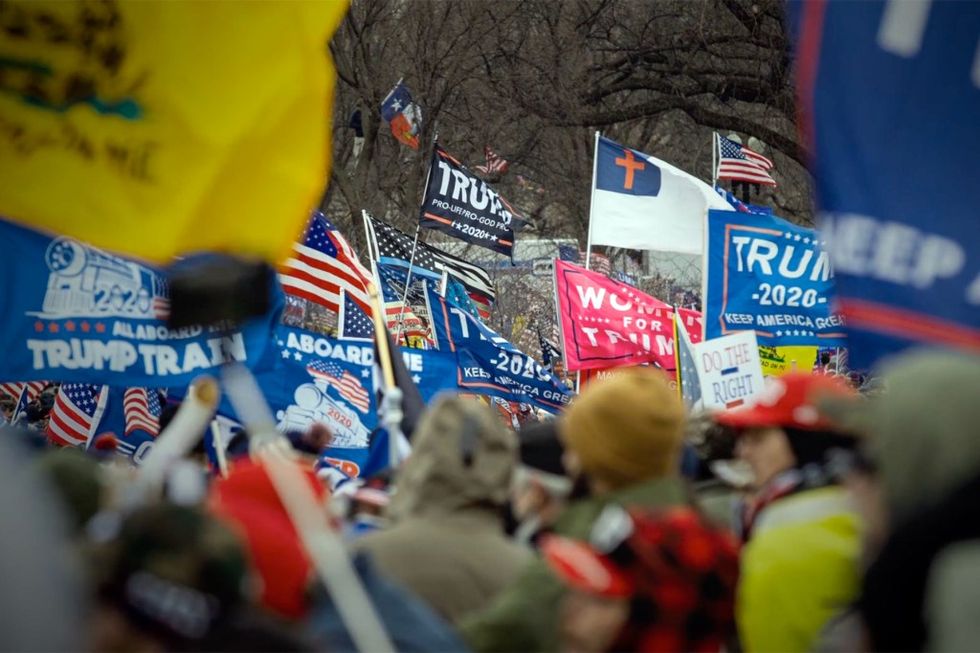
As a result, said Stewart, “Christian nationalism was an inescapable part of the attempted coup, and it remains a cornerstone of the MAGA movement and Trumpism.” Not everyone at the capitol on Jan. 6 was a Christian nationalist, but look at the videos and you’ll see a lot of Christian flags, Jesus 2020 signs, and religious imagery (crosses, shofars).
Perhaps the most disturbing part of God and Country is that things may well get worse, even if Joe Biden wins the next election. While Christian nationalists see America as a Christian nation and think a majority of Americans support them, this is far from the case. In fact, nearly two-thirds of Americans support the right to obtain an abortion, nearly three quarters support same-sex marriage.
Moreover, Christian nationalism is white. According to exit polls, 80 percent of white evangelicals (who make up a quarter of the U.S. population) voted for Trump. Ninety percent of Black Christians voted for Biden. And the white Christian demographic, once dominant, is steadily declining — which is one reason many Christian nationalists have openly opposed democracy itself. Between America’s sacred, God-ordained mission and democracy, the choice for Christian nationalists is obvious.
These people are armed, they have their own media and cultural universes, they think that they’re fighting for the soul of America (as well as their own salvation), and they won’t simply go away if Biden wins in November. Even if they’re a minority, they’re an enraged, and heavily organized minority — and increasingly a threat to the American experiment.
“Can we preserve 249 years of self-rule created by the Founding Fathers, or will we slip into a theocratic autocracy?” asks Reiner. “We’re seeing the rise of autocracy and theocracy around the world — Donald Trump is the vessel for that to happen here in the United States. This is a movement that can potentially destroy everything that we’ve worked for.”



 Sunsara Taylor (right, with Michelle Xai) is a leader and co-founder of Refuse Fascism.Juliana Yamada/Los Angeles Times/Getty Images
 Bob Avakian (pictured in 2014), who founded the Revolutionary Communist Party, has ties to Refuse Racism.Courtesy of The Bob Avakian Institute
 Members of the Revolutionary Communist Party march from the South End to Boston Common during May Day in Boston, May 1, 1980.Tom Landers/The Boston Globe/Getty Images
 Activists with RevComs held the protest near MacArthur Park in December 2024 ahead of President-elect Trump’s planned wave of migrant deportations.Mario Tama/Getty Images
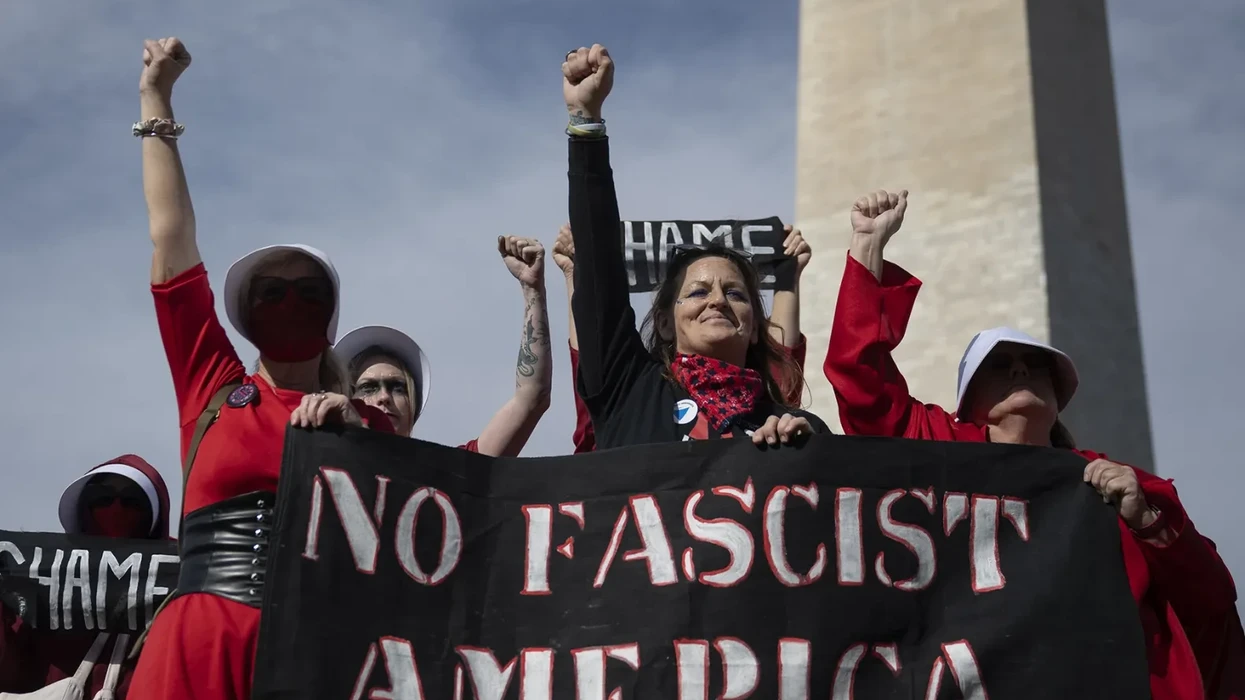
 Refuse Fascism protestors hold a rally around the Washington Monument on November 5, 2025.Celal Gunes/Anadolu/Getty Images



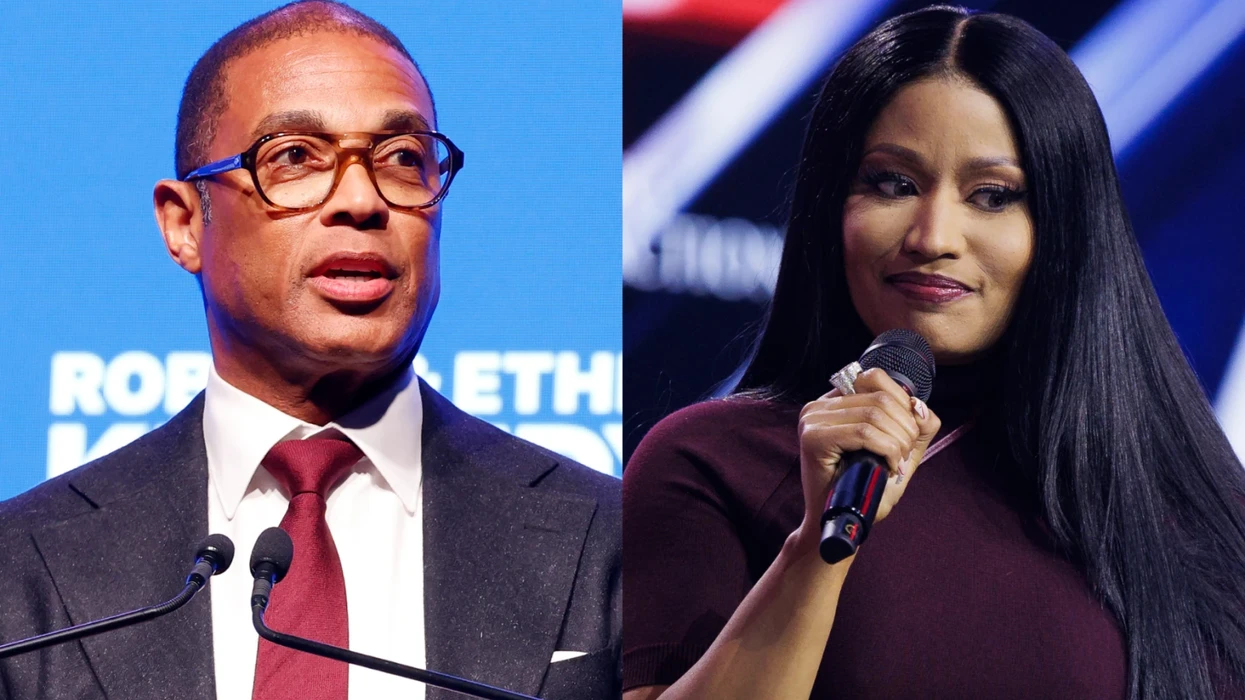



‘They’re Frightened of Diversity’: Rob Reiner on the Threat of Christian Nationalism