
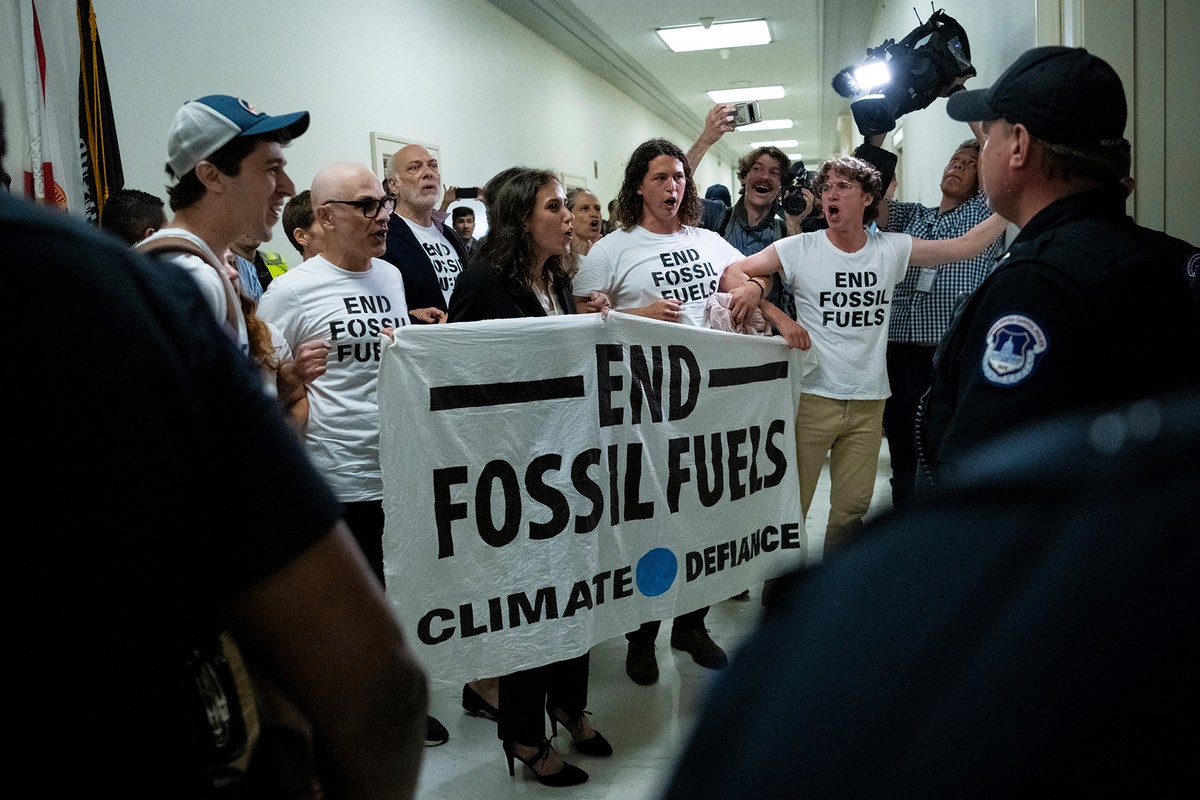

NEW YORK — Activists and donors, young and old, packed into a luxury co-op on the Upper West Side last Wednesday to celebrate the one-year birthday of Climate Defiance, a disruptive climate action group that is quite good at making powerful politicians, government officials, and corporate executives uncomfortable — with the goal of trying to end our reliance on fossil fuels.
Climate Defiance Executive Director Michael Greenberg put this power on full display at the event, as he gave supporters an excruciatingly hard sell, for what felt like an eternity, asking them to fund the organization’s in-your-face climate activism — and help take it national.
“In one year, we’ve reached 70 million people on Twitter, with $0 in paid ads,” said Greenberg, noting his organization’s activism has been covered in The New York Times, Bloomberg, The Guardian, and by this reporter in Rolling Stone. “This is absolutely having an impact,” he said. “And if we can do this in one year, on pretty much just the East Coast, imagine what we could do if we had twice the budget. We could be doing this in Chicago, L.A., and Houston — in the belly of the beast of the oil industry. Imagine what we could do if we had a real vibrant, distributed organizing program, so that people in small cities and [in] Omaha, Denver, and Minneapolis have the support they need to start their own chapters.”
Greenberg said that in just one year, Climate Defiance hounded several prominent officials so badly they quit their jobs. He noted the group protested Interior Department official Tommy Beaudreau, or “the climate criminal who personally signed off on the Willow Project, [and] 15 days later he resigned.”
“We protested Jody Freeman, who’s a member — was a member — of the board of directors at ConocoPhillips,” he continued. “We gave her the ‘Big Oil Bestie’ award, we shut down the whole Harvard climate change conference where she’s affiliated.” She resigned from ConocoPhillips and kept her role at Harvard University.
Outside of the Climate Emergency Fund, a Los Angeles-based nonprofit that funds organizations that lead disruptive climate actions, Greenberg told the crowd, there are few foundations willing to finance his group’s work, which has included bird-dogging politicians like coal baron Sen. Joe Manchin (D-W.Va.) or ExxonMobil CEO Darren Woods.
“If we are to keep doing this work, it will be because people in this room give us money,” he said, calling on one donor in the room to give $20,000. His rationale for that number was a bit convoluted — honestly, it was a lot to follow — yet powerful nonetheless.
Climate Defiance’s targeted, disruptive activism played a key role in convincing the Biden administration to pause a decision on whether to approve CP2, a liquefied natural-gas (LNG) export terminal that would be the largest in the United States — and also temporarily pause all pending decisions on new LNG export projects. As Greenberg noted at the event, the White House specifically included a quote from Climate Defiance in a press release about its decision to pause new LNG decisions.
“If you stopped all proposed LNG build-out, that’s the equivalent of stopping 500 coal plants,” Greenberg said, extrapolating from there to suggest his group’s activities last year ultimately “had the impact of shutting down 25 coal plants.”
He continued: “Our annual budget is about $500,000 per year. So $500,000, divided by the 25 coal plant equivalents we’ve shut down, shows that for every $20,000, you have the impact of shutting down the equivalent of one coal plant.”
When he finally made the ask, it worked almost immediately: A man pledged $20,000 on the spot.
“That is incredible. I am blown away,” Greenberg said, before asking if anyone else was ready to give $20,000. It worked, again, as a foundation executive pledged to give that much, too.
Greenberg asked again: “Is there one more person ready to make a $20,000 commitment to Climate Defiance?”
After some awkward silence, Steven Donziger — an environmental justice lawyer who was imprisoned and held under house arrest for nearly three years due to his role in a $9.5 billion judgment against Chevron — stepped in and joked, “The discomfort is part of the strategy.”
“The New Republic ran a piece on Climate Defiance, which was otherwise a very nice piece,” Greenberg said, “but they said that I am ‘lanky and awkward.’ So then I quote tweeted [them] and said, ‘Nobody has ever called me ‘lanky.’” He explained, “I think part of why I’m able to do this is that I don’t always get too concerned about social norms.”
After lowering the ask to $10,000, Greenberg joked that Sen. Amy Klobuchar (D-Minn.) “once told me that I take things too far — but tonight, I am ready to prove her absolutely right.”
Later, as Greenberg asked for $5,000, he noted the group may have spent that much on tickets to attend the event with ExxonMobil’s CEO, where the organization unfurled a banner proclaiming, “Eat shit Darren.” Greenberg noted that the video got more than 5 million views on X, the social media platform formerly known as Twitter.
As the total haul eclipsed $60,000, Greenberg said that raising $70,000 “will be enough to make Joe Manchin crawl into a cave, and place a giant boulder in front, and hide out there in shame for the rest of his life.”
By the end, after roughly 30 exhausting minutes of hard selling, Greenberg reached that $70,000 goal — which was far more than anyone in the room could have expected.
Margaret Klein Salamon, executive director at the Climate Emergency Fund — which has financially supported Climate Defiance from the start — was stunned. Afterwards, she tells Rolling Stone she’s going to use Greenberg’s strategy to raise money herself: Discomfort works.





Donald Trump speaks in front of the American flag at the White House, on May 12, 2026.
It’s the Corruption, Stupid
Let’s say it plainly: There has never been a president as corrupt as Donald Trump. There is no close second in our history.
Take two days in May as Exhibit A. Americans just found out that in the first quarter of this year, Trump’s stock portfolio made 3,600 trades — an average of nearly 60 a day. This is a rapacious pace that would make a day trader on meth blush. Many of these appear suspiciously timed to benefit from actions approved by the president himself. For example, his Nvidia stock surged after Trump announced the company would be permitted to sell its cutting-edge AI chips to China. Similar suspiciously well-timed calls were made ahead of big government moves involving other companies, from Intel to Palantir to Boeing. The Trump Organization says all trades are made by a third-party investment advisor. If so, they appear to be psychic.
But the apparent insider trading scam being run from within the Oval Office is small change — merely millions of dollars — compared to the self-dealing plunder of $1.8 billion tax-payer dollars being pushed through the DOJ and IRS.
There’s never been a sitting president who sued his own government for $10 billion. That’s because it’s absurdly corrupt. But that’s what Donald Trump did, arguing he had suffered damages from prosecutions pursued before he was reelected. Trump, like many of his supporters, persistently confuses persecution with prosecution.
The judge who heard the case convened an independent panel to review the suit, suspecting it might be a scam. Before the case could be dismissed, Acting Attorney General Todd Blanche — who had previously served as Trump’s personal lawyer — declared that the bogus suit would be preemptively settled, not for $10 billion, but for the symbolic sum of $1.776 billion, which Trump said will be distributed to persecuted political allies.
This is a shakedown. The president is compelling a Justice Department he controls to redirect money from taxpayers — that’s you — to his most fervent supporters. This slush fund will set off a cash grab among MAGA lawyers and be used to reward partisan fanatics who attacked the U.S. Capitol — and police officers — on his behalf.
If that wasn’t enough of a blatantly illegal use of presidential power, it was revealed that the “settlement” deal included a pledge signed by the acting attorney general that would ensure — in the hysterical all caps of a Trump tweet — that the government would be “FOREVER BARRED and PRECLUDED from prosecuting or pursuing” any tax claims, audits or related prosecutions against Trump, his family or their businesses. This is an attempt to get a permanent get-out-of-jail-free card for the Trump family — a license to steal.
All of this is insane. All of it is unethical, and much of it is illegal and impeachable — but our system was not designed to deal with a shamelessly self-dealing president, a spineless Republican Congress, and a complaint conservative Supreme Court that has refused to enforce the emoluments clause of the Constitution and ruled that Trump has immunity for actions he takes as president. That ruling may prove to be the most consequential — and most corrosive — act of judicial abdication in American history. Against this partisan-group think, individual acts of courage matter. So kudos to the top lawyer at the Treasury Department, Brian Morrissey, who at least had the integrity to resign rather than oversee this tax-payer funded plunder.
Just to close out the corruption-palooza, Trump announced that he would endorse the Lone Star State poster-boy of corruption, Texas Attorney General Ken Paxton, in his primary against incumbent GOP Senator John Cornyn. Paxton’s scandals include a truly buffoonish array of fraud and bribery charges that resulted in him nearly being impeached by the state legislature. But corruption is a feature, not a bug, of Trumpland.All this smacks of late Rome and you’d be forgiven for half expecting Trump will next appoint a horse to an open Cabinet position, with Republicans rationalizing the need for more equine representation. It is no more absurd that the cavalcade of Trump appointees refusing to say that Biden won the 2020 election during their confirmation hearings in the Senate. The decision to parrot unreality for partisan gain defines deviancy down.
But in the search for something hopeful to hold onto in dark times, you can find some comfort in the fact that corruption is often the thing that turns the tide against authoritarian-adjacent administrations. And there is evidence this is happening.
Trump’s billions in self-enrichment, his reflexive twisting of U.S. policy to sell out long-term national interests and enduring values, comes at a moment when nearly half of Americans say they are feeling extremely anxious about their own financial situation.
That anxiety is driven by the widening gap between Main Street and Wall Street, a gap set on fire by a trade war and a real war Trump started, which has no end in sight but promises to further raise energy prices, fertilizer prices, and strangle the global economy. While CEOs embrace the transactional nature of this president, kissing his ring and offering vigs, the situation is grim if you’re not lining up at the Trump trough. At a time when the super-rich are getting richer, everyone else is told to go to hell by the man in the White House.
These are precisely the kinds of conditions that turn people against an aging, autocratic president who shows contempt for the very people who put him in office. It is not just that Trump’s approval numbers have plummeted to the point where two-thirds of Americans disapprove of the job he is doing. It is that Trump, for the first time, is opposed by a majority of non-college-educated white voters — a.k.a. his base — and they feel betrayed because Trump is raking in billions of dollars while they struggle to pay rent and buy groceries. Trump has dismissed and discounted their concerns, turning a blind eye to the anger about rising costs that carried him back into the presidency.
Trump’s aim is to make his thievery so blatant that we collectively become numb to it and disfigure our democracy in the process. Once upon a time conservatives warned about the dangers of “crony capitalism” and corruption. Now they are silent and complicit. It is the temporary triumph of partisanship over principle. Patriotism demands that we reassert the basic American idea that no man is above the law and that our presidents are not kings.