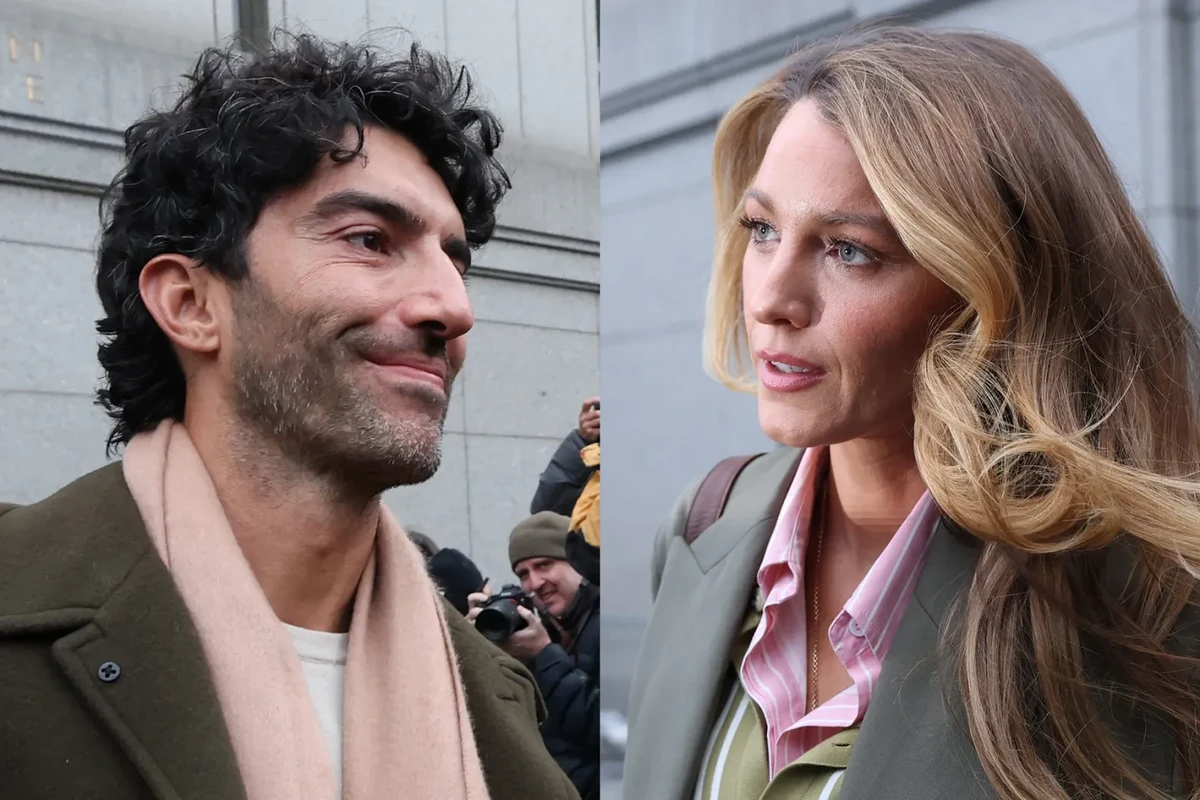

A federal judge has tossed Blake Lively’s high-profile sexual harassment and defamation claims against Justin Baldoni and his studio partners, scaling back her bombshell lawsuit involving the domestic violence movie It Ends With Us just six weeks before a trial in Manhattan federal court.
In a new 152-page ruling Thursday, U.S. District Judge Lewis Liman struck down 10 of Lively’s 13 causes of action, leaving only her claims for retaliation and breach of contract against the movie’s producers, as well as her aiding and abetting retaliation claim against The Agency Group PR. A trial in the case is set to begin May 18.
In her lawsuit first filed on Dec. 31, 2024, Lively claimed Baldoni, the movie’s production company Wayfarer Studios, and the other defendants subjected her to “disturbing” sexual harassment during the movie’s production, then targeted her with a “sophisticated, coordinated, and well-financed” online smear campaign after she spoke up. Lively said the defendants wanted to “silence” and “eviscerate” her before she had a chance to go public with her claims.
In one notable passage of the opinion, Judge Liman rejected Lively’s claim that Baldoni’s improvised actions during the filming of a slow-dance scene, in which he “slowly dragged his lips from her ear down her neck” while whispering, “it smells so good,” created a hostile work environment.
“There is no question that this conduct might support a hostile work environment claim if it occurred on the factory floor or in the executive suite. But in all sexual harassment cases, the court must carefully consider the social context in which particular behavior occurs and is experienced by its target,” the judge wrote. He focused on whether Baldoni’s conduct reflected hostility or bias based on gender.
“He was acting in the scene. Assuming he was improvising, the conduct was not so far beyond what might reasonably be expected to take place between two characters during a slow dancing scene,” the judge wrote. “The conduct was directed to Lively’s character rather than to Lively herself. Creative artists, no less than comedy room writers, must have some amount of space to experiment within the bounds of an agreed script without fear of being held liable for sexual harassment.”
The judge said there was evidence that Lively was pressured to film a birth scene appearing nude from the waist down, covered only by a “thin piece of black fabric,” without a closed set or an intimacy coordinator, in violation of her contract. He also cited testimony that Baldoni told crew members Lively had never watched pornography, a remark he said “bore no apparent connection to the creative process” and singled her out in a way that could be interpreted as sexual. Viewing the record in the light most favorable to Lively, the judge found “sufficient evidence” that she could reasonably believe she was subjected to a hostile work environment.
But the sexual harassment claims failed on legal grounds, according to the ruling. The judge concluded that Lively was an independent contractor, not an employee covered by the statutes she invoked, noting there was “no genuine dispute” that she exercised extensive control over decisions related to the film and her role.
In upholding the retaliation claims, the judge said “certain conduct at least arguably crossed the line.” He said Baldoni and his studio partners had a right to hire public relations and crisis management specialists to protect their reputations. But, the judge wrote, “there are limits to the response that the accused can make in response to claims of harassment. There comes a point where the accused stops simply defending him or herself and starts taking action that a reasonable jury could view as retaliation for the fact that the accuser had the temerity to make the accusations.”
Lively’s lawyer Sigrid McCawley issued a statement Thursday saying the bulk of Lively’s sexual harassment claims were set aside not because they had no merit, but because Lively was found to be an independent contractor, not an employee.
“This case has always been and will remain focused on the devastating retaliation and the extraordinary steps the defendants took to destroy Blake Lively’s reputation because she stood up for safety on the set, and that is the case that is going to trial,” McCawley said. “For Blake Lively, the greatest measure of justice is that the people and the playbook behind these coordinated digital attacks have been exposed and are already being held accountable by other women they’ve targeted. She looks forward to testifying at trial and continuing to shine a light on this vicious form of online retaliation so that it becomes easier to detect and fight.”
Baldoni’s lawyers, Alexandra Shapiro and Jonathan Bach, declared victory on Thursday. “We’re very pleased the court dismissed all sexual harassment claims and every claim brought against the individual defendants,” they said, referring to allegations that singled out Baldoni, his producing partners Jamey Heath and Steve Sarowitz, and the public relations professionals Melissa Nathan and Jennifer Abel as personally liable apart from the corporate defendants.
“These were very serious allegations, and we are grateful to the Court for its careful review of the facts, law, and voluminous evidence that was provided,” the defense lawyers said. “What’s left is a significantly narrowed case, and we look forward to presenting our defense to the remaining claims in court.”
Lively’s battle with Baldoni first made headlines in late 2024, when The New York Times published a Dec. 21, 2024 story titled “‘We Can Bury Anyone’: Inside a Hollywood Smear Machine.” The story revealed Lively had filed a precursor complaint against Baldoni with the California Civil Rights Department.
Since then, the legal battle has pulled in other famous people, including Lively’s husband, Ryan Reynolds, and superstar musician Taylor Swift. In a 2024 text message revealed in court filings, Swift appeared to refer to Baldoni when she wrote, “I think this bitch knows something is coming because he’s gotten out his tiny violin.”
Other messages appeared to show Lively referring to herself as Game of Thrones character Khaleesi, with Reynolds and Swift purportedly described as her “dragons.” She called Baldoni a “clown” in another message to Swift.



 Steve Cohen*